
What Is NJDOC?
NJDOC is the agency abbreviation used by the New Jersey Department of Corrections on its own website. The agency's Contact Us page uses the NJDOC navigation label, and its About page identifies the department as the New Jersey Department of Corrections. For inmate-search purposes, NJDOC is the state prison and state corrections custody system. It is not the county jail network, the federal Bureau of Prisons, ICE, VINELink, or New Jersey Courts.
The department says it is comprised of 9 correctional facilities, 11 Residential Community Release Programs, and 1 Assessment Center. Its main prison facilities are Adult Diagnostic and Treatment Center, Bayside State Prison, East Jersey State Prison, Edna Mahan Correctional Facility for Women, Garden State Youth Correctional Facility, Mid-State Correctional Facility, New Jersey State Prison, Northern State Prison, and South Woods State Prison. The NJDOC inmate population should be read through that state system, not through a single county's roster.
The NJDOC About page confirms the agency name, mission, and main facility count.
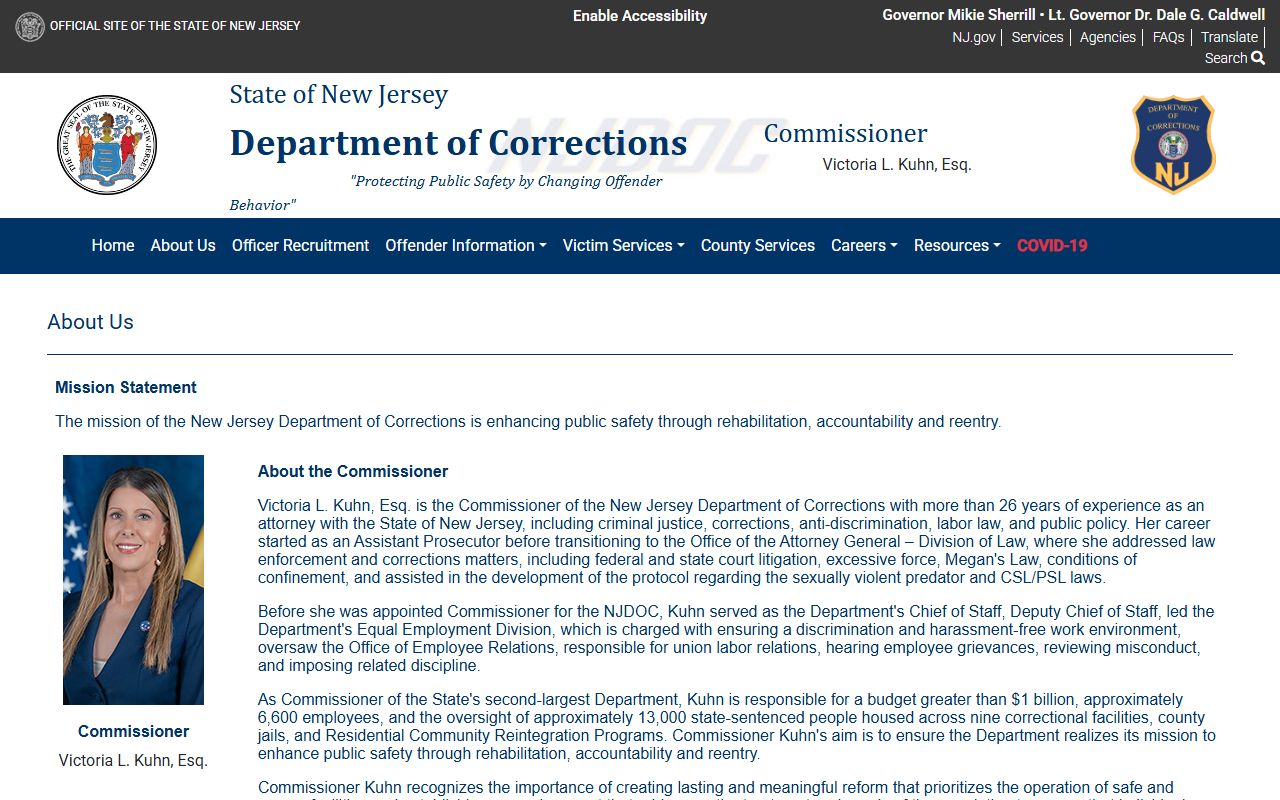
The agency source matters because the official abbreviation, facility count, and custody role all come from NJDOC itself.
The NJDOC Inmate Population
The current NJDOC inmate population baseline in the research is the Population Characteristics Report 2026. It states that the report covers incarcerated persons in each correctional complex, major institution, and satellite housing unit under NJDOC jurisdiction on January 1, 2026. NJDOC reported 12,471 incarcerated persons under its custody on that date. Of that total, 10,969 were in the prison complex, 1,275 were in Residential Community Reintegrative Programs, county jails, ECCF-TPV, and Capital Health Regional Medical, and 227 were Interstate Corrections Compact cases.
| Category | Count | Source / date |
|---|---|---|
| NJDOC total custody | 12,471 | Population Characteristics Report, January 1, 2026 |
| Prison complex | 10,969 | Population Characteristics Report, January 1, 2026 |
| RCRP, county jail, ECCF-TPV, hospital category | 1,275 | Population Characteristics Report, January 1, 2026 |
| Interstate Corrections Compact | 227 | Population Characteristics Report, January 1, 2026 |
How to Search the NJDOC Inmate Locator
The official NJDOC offender search is the public locator for the New Jersey Department of Corrections inmate population. It should be used when a person is believed to be in state prison, has been transferred from county jail into state custody, appears in an NJDOC residential community release setting, is in work release or furlough status under NJDOC, or otherwise belongs to state corrections custody. It is not the first tool for a person arrested that day and still moving through county intake.
- Open the NJDOC offender search.
- Read the public warning before relying on location, status, release date, or other fast-changing details.
- Search after the disclaimer page using the fields exposed by the official form.
- Compare results with county jail records and NJ Courts when the person is newly arrested, recently sentenced, or recently transferred.
- Send written questions about posted offender-search data to the NJDOC Correspondence Unit address listed on the locator page.
The NJDOC offender search warning page explains the biweekly update schedule and public information limits.
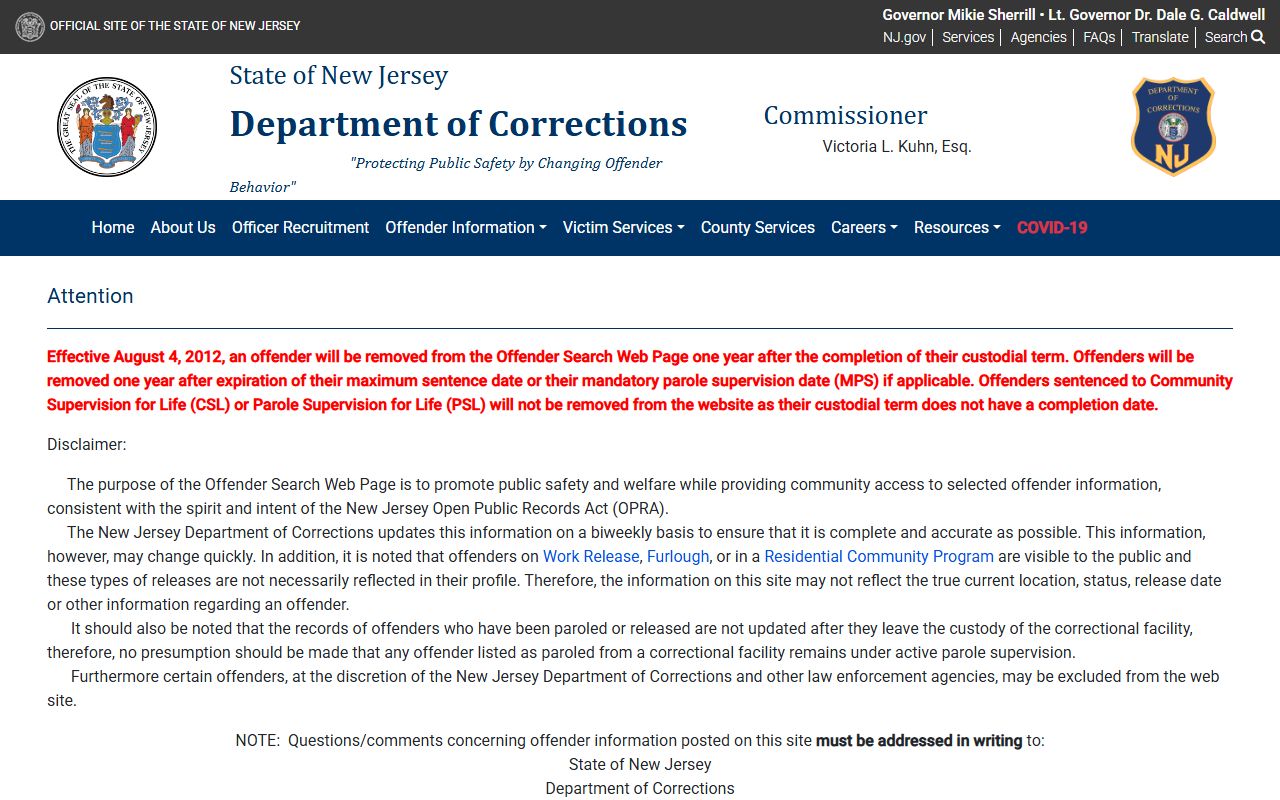
The warning is part of the search process because NJDOC says location, status, and release information may change quickly.
What an NJDOC Record Shows
NJDOC describes the offender search as selected offender information made available for public safety and welfare consistent with the spirit and intent of OPRA. That phrasing is important. An NJDOC inmate record is not the person's full institutional file, medical file, sealed case record, juvenile record, disciplinary history, or court transcript. It is a public locator and status record from the state corrections agency.
| Record element | How to read it |
|---|---|
| Identity information | Used to distinguish one state corrections record from another. |
| Custody or location data | May lag a transfer, release, work release status, furlough, or residential community placement. |
| Sentence or release information | Should be verified before legal, travel, or family decisions are made. |
| Removal from search | NJDOC says an offender is removed one year after completion of the custodial term, except CSL and PSL cases without a completion date. |
Phone inquiries about offender information cannot be honored according to the NJDOC search page. Written questions about posted offender information go to State of New Jersey, Department of Corrections, PO Box 863, ATTN: Correspondence Unit, Trenton, NJ 08625.
NJDOC Prisons and Facilities
The NJDOC inmate population is housed through a state prison network, not through one county facility. Institution counts in the 2026 report include Adult Diagnostic and Treatment Center with 424 people, Bayside State Prison with 1,283, East Jersey State Prison with 875, Edna Mahan Correctional Facility for Women with 389, Garden State Youth Correctional Facility with 1,034, Mid-State Correctional Facility with 307, New Jersey State Prison with 1,288, Northern State Prison with 2,115, and South Woods State Prison with 3,254.
Security-level wording should stay broad. The research supports references to minimum, medium, maximum, close or restrictive housing, reception and assessment, special-mission facilities, women's custody, sex-offense treatment, and residential community release. It does not support assigning one static custody level to each person. Classification, housing, and custody levels are individual and are managed within NJDOC.
| NJDOC facility | County context | Jan. 1, 2026 count |
|---|---|---|
| Adult Diagnostic and Treatment Center | Middlesex County | 424 |
| Bayside State Prison | Cumberland County | 1,283 |
| East Jersey State Prison | Middlesex County | 875 |
| Edna Mahan Correctional Facility for Women | Hunterdon County | 389 |
| Garden State Youth Correctional Facility | Burlington County | 1,034 |
| Mid-State Correctional Facility | Burlington County | 307 |
| New Jersey State Prison | Mercer County | 1,288 |
| Northern State Prison | Essex County | 2,115 |
| South Woods State Prison | Cumberland County | 3,254 |
The NJDOC visitation page lists the state's main facilities and appointment information.
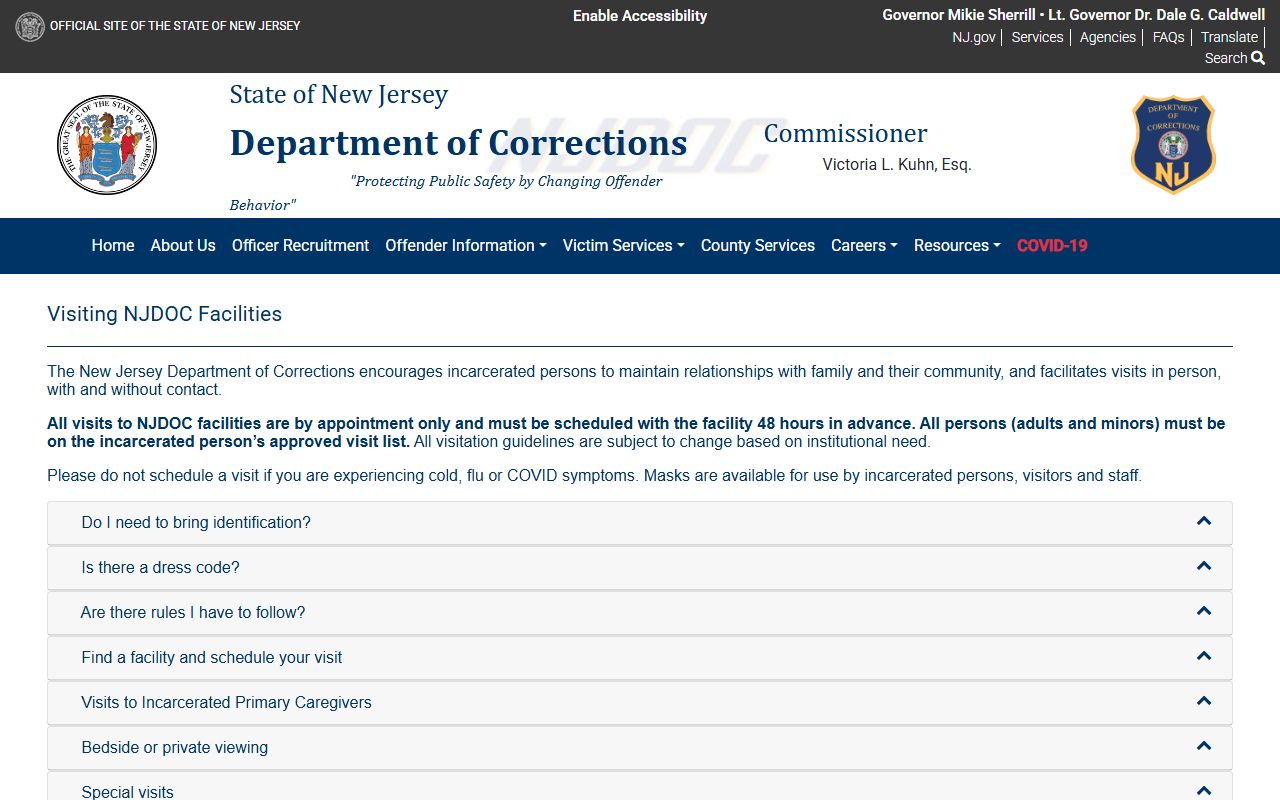
Visitation source material is useful for facility identity and contacts, but an inmate lookup still begins with the NJDOC offender search.
NJDOC Inmate Population Trends
The NJDOC inmate population has declined across the research snapshots. NJDOC reported 12,978 total custody on January 1, 2024, 12,856 on January 1, 2025, and 12,471 on January 1, 2026. The change from 2024 to 2026 was 507 fewer people in total custody. The change from 2025 to 2026 was 385 fewer people. Those figures should be tied to their dates because custody populations are not fixed.
| Date | NJDOC total custody | Trend note |
|---|---|---|
| January 1, 2024 | 12,978 | Earlier annual population report snapshot |
| January 1, 2025 | 12,856 | Lower than 2024 by 122 |
| January 1, 2026 | 12,471 | Lower than 2025 by 385 |
The 2026 report also supplies offense and sentence context. It reports that 73% of all NJDOC incarcerated persons are committed for crimes against persons or violent crimes, the median total term is 7 years, 46% have total terms of 10 years or more, 7% are serving life sentences, and 78% have sentences that include mandatory minimum terms.
NJDOC Sentencing and Parole
New Jersey sentencing and parole are court- and statute-driven. The NJ Courts Manual on New Jersey Sentencing Law says the sentencing court must explain parole laws as they apply to the sentence and state the approximate period the defendant will serve before parole eligibility, jail credits, entitlement to good time and work credits, and possible Intensive Supervision Program eligibility. That framework belongs to the sentence and the court record before it becomes an NJDOC custody issue.
The New Jersey State Parole Board parole handbook is written for adult and young adult offenders committed to the State Prison Complex or Youth Correctional Complex. It says it does not cover juvenile offenders or offenders sentenced to county jails or county correctional facilities. Parole eligibility does not guarantee release. Mandatory minimums, parole disqualifiers, credits, disciplinary issues, detainers, sentence aggregation, civil-commitment or sex-offense treatment provisions, and Interstate Corrections Compact placements can affect the real date.
- Jail credit
- Credit the sentencing court may apply for time already spent in custody.
- Mandatory minimum
- A period that must be served before parole eligibility or release rules can operate.
- Parole eligibility
- The point when parole review may occur, not a promise of release.
- Residential community release
- A state custody or reentry setting listed by NJDOC outside the main prison complex.
NJDOC vs County Jail
NJDOC inmate population searches and county jail searches answer different questions. A county jail roster is the better starting point for a new arrest, pretrial detention, a short county sentence, a local hold, or a regional transfer. NJDOC is the better starting point after the person has entered state corrections custody. New Jersey's county jail geography is regional in several counties, so the county tied to the arrest may not be the building where the person sleeps.
| Issue | NJDOC | County jail |
|---|---|---|
| Primary population | State-sentenced and state custody persons | Recent arrests, pretrial detainees, local sentences, holds |
| Search source | NJDOC offender search | County roster, regional jail, VINELink, county custodian |
| Update warning | NJDOC says biweekly and subject to fast changes | Varies by county and vendor |
| Records request | OPRA Central and state request form | County OPRA custodian or county portal |
For county custody routing, use the New Jersey county directory. For state prison and facility rows, use the New Jersey facility directory.
NJDOC Mail and Money
NJDOC family contact rules are statewide prison rules. The Staying Connected page says NJDOC is implementing mail copying and screening for all United States Postal mail for each of the nine correctional facilities. The ViaPath page says NJDOC began a transition from JPay to ViaPath Technologies and ConnectNetwork for communications and financial transactions beginning in March 2025. Those details should not be copied onto a county jail unless county research confirms that the same vendor or rule applies locally.
The NJDOC Staying Connected page explains statewide state-prison mail and communication rules.
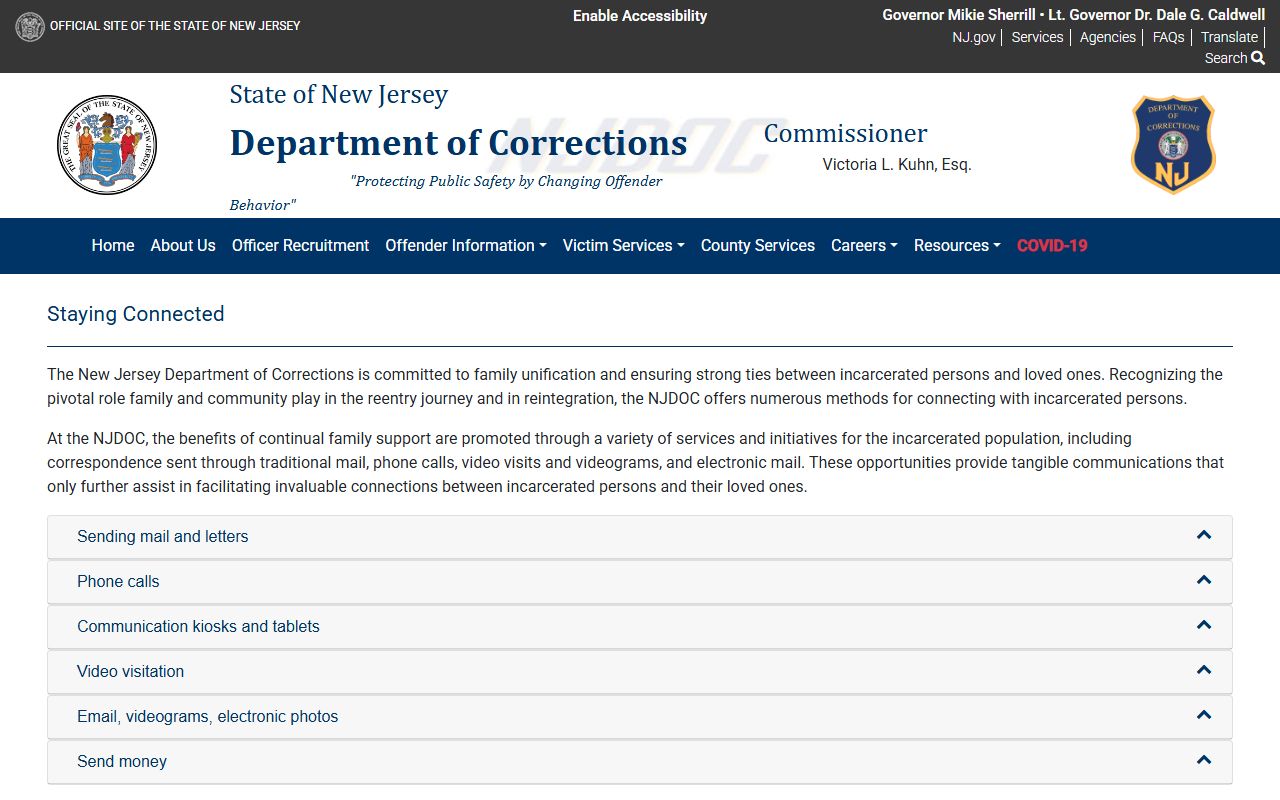
Mail, calls, deposits, and visits are practical custody issues, but they still depend on whether the person is in NJDOC custody or county custody.
The NJDOC ViaPath page describes the 2025 communications and financial transaction transition.
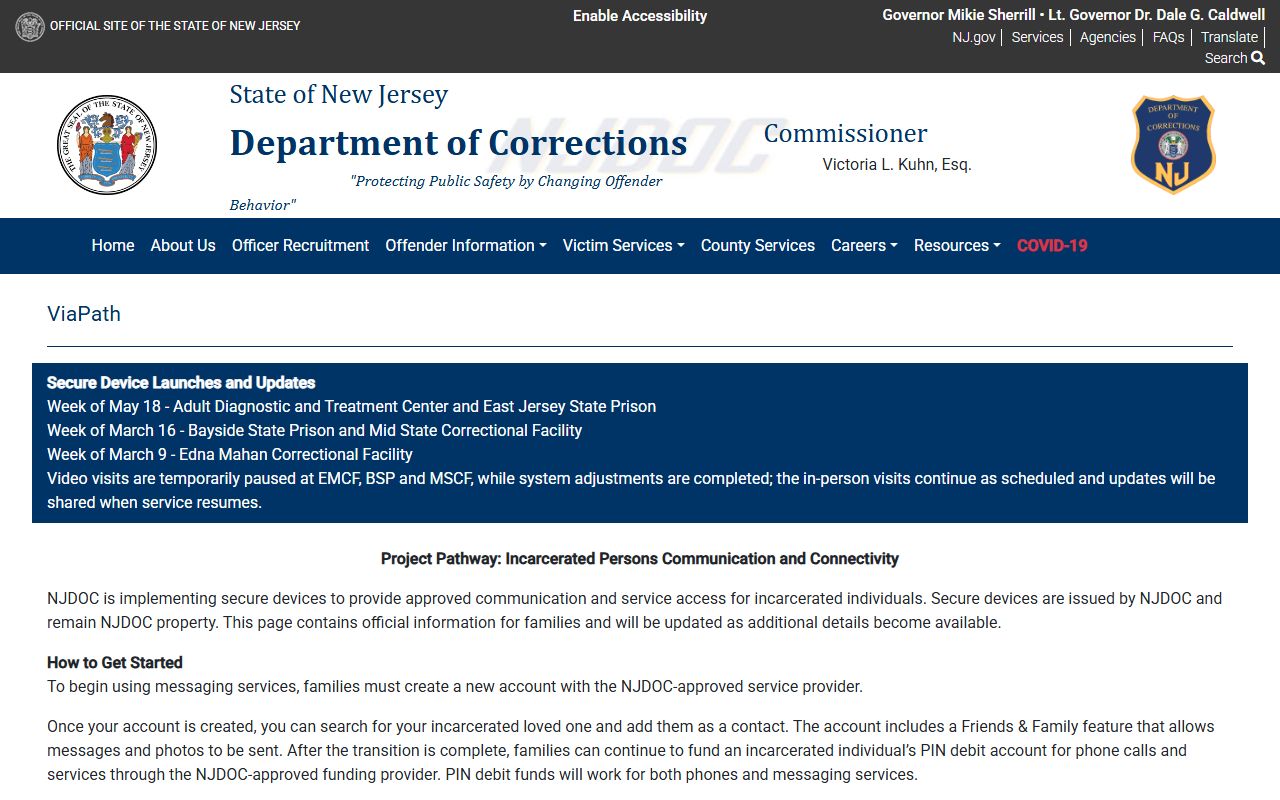
The vendor transition is a state-prison detail, so county jail deposit or messaging rules must be checked with the county facility.
NJDOC Records Requests
New Jersey's public-records law is OPRA, N.J.S. 47:1A-1 et seq. OPRA Central is the statewide access hub, and the state request form instructions include Corrections as a department option. OPRA requests should describe specific records, date ranges, facilities, names or identifiers where legally appropriate, and the preferred delivery method. OPRA is not a way to ask NJDOC to explain a release date or calculate credits. It is a request process for identifiable government records.
- Start at OPRA Central.
- Use the state records request form when the record is held by a state department.
- Select Corrections when the record is an NJDOC record.
- Use the NJDOC Correspondence Unit route for written questions about offender-search information posted on the locator page.
- Use NJ Courts, county custodians, BOP, or ICE when the record is not an NJDOC record.
NJDOC Inmate Population FAQ
How large is the NJDOC inmate population?
NJDOC reported 12,471 incarcerated persons under its custody as of January 1, 2026. The prison complex held 10,969 of that total, with additional people in state custody categories such as RCRP, county jail, ECCF-TPV, hospital, and Interstate Corrections Compact cases.
How often is the NJDOC inmate locator updated?
The NJDOC offender search warning says information is updated on a biweekly basis. It also warns that information may change quickly and may not reflect the true current location, status, release date, or other information.
When does NJDOC remove a person from public search?
NJDOC says an offender is removed from the public offender search one year after completion of the custodial term, measured from maximum sentence expiration or mandatory parole supervision date where applicable. CSL and PSL cases are not removed on that basis because the custodial term lacks a completion date.