
How Court Records After a New Jersey Arrest Begin
A New Jersey arrest creates more than one trail. The booking side belongs to the jail or corrections agency that receives the person. That record may show name, booking date, facility, roster status, release notes, detainers, and charges as transmitted to the jail. The court side begins when a complaint, indictment, criminal judgment, municipal filing, or other case document is entered into the New Jersey Judiciary system. Those court records after an arrest are not the same thing as an inmate roster, and they may update on a different schedule.
That distinction matters because users often treat a jail charge line as a final case outcome. Booking charges can be amended, downgraded, superseded by indictment, dismissed, merged, or resolved by plea. A person may also leave jail before the court record is resolved. The court file is the better source for case status, complaint numbers, indictment numbers, criminal judgments, and municipal-case information. The jail record is the better source for current custody, transfer, or local release status.
The New Jersey Courts Find a Case page is the statewide entry point for public court-record searches.
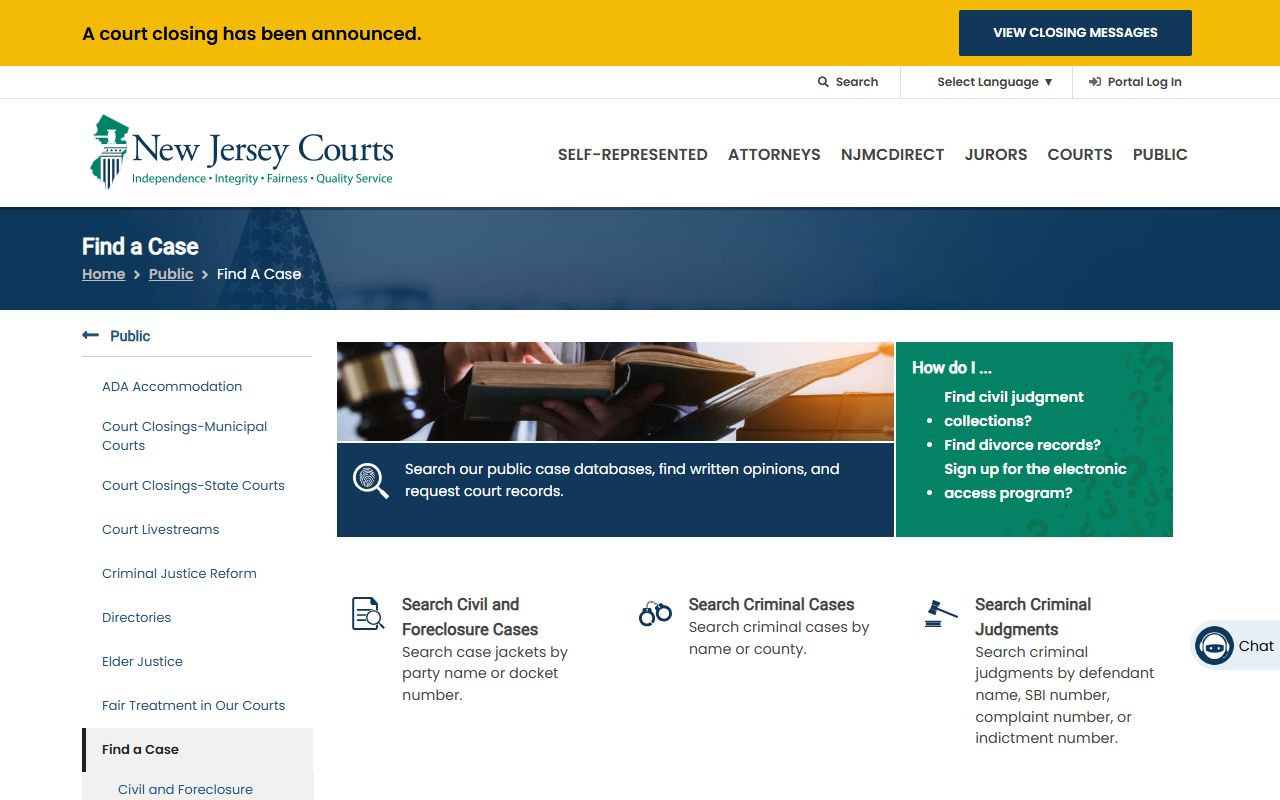
That portal is the place to start when the question is about charges, case records, or judgments rather than where the person is housed tonight.
How New Jersey Court Records and Jail Records Fit Together
New Jersey Courts operates statewide public case-search tools, including Find a Case, PROMIS/Gavel Public Access for criminal case search, Municipal Court Case Search, and Criminal Judgments Public Access. The research identifies these channels as the routes for searching criminal cases by name or county, criminal judgments by defendant name, SBI number, complaint number, or indictment number, and municipal matters by ticket number, complaint number, license number, or name. The tools do not replace county jail rosters. They answer a different question: what formal case exists after the arrest?
When someone is arrested locally, the county jail may be the first visible public record. After filing, the court system becomes the source for the legal case. A county jail roster can show custody and charges as received from the committing authority. NJ Courts can show case filings, complaint or indictment identifiers, judgments, municipal case records, and court events. Neither system is guaranteed to explain the other completely. A release from jail is not a dismissal. A pending court case does not prove the person remains in custody.
How to Find New Jersey Court Records After an Arrest
The practical search starts with the agency that can answer your current question. If the question is custody, use New Jersey inmate records, a county roster, NJDOC, BOP, ICE, or VINELink. If the question is the charge path after the arrest, use NJ Courts. For local context, open the County Directory and confirm the county where the arrest, complaint, or detention took place.
- Open the New Jersey Courts Find a Case hub and choose the search tool that matches the matter: criminal case search, criminal judgments, or municipal case search.
- Search with the strongest available identifier, such as defendant name, county, complaint number, indictment number, SBI number, ticket number, or license number where the tool allows it.
- Compare the court result with the county jail record. A jail roster charge may not match the final filed charge or judgment.
- Check whether the matter belongs in municipal court, a criminal case search, or a criminal judgment database. Traffic, ordinance, and lower-level matters may not appear in the same place as indictable criminal cases.
The Municipal Court Case Search page is one of the court channels for matters that do not follow the same path as a state-prison sentence or county jail roster entry.
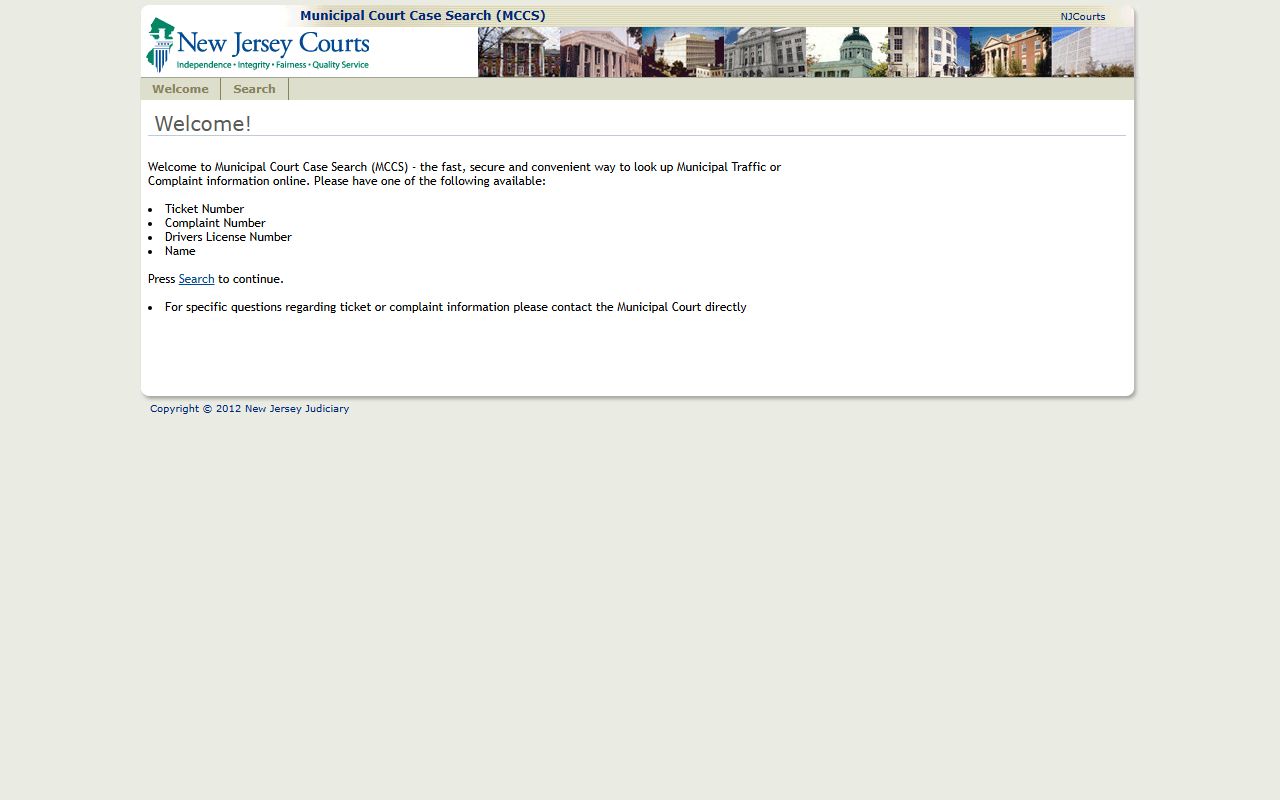
Municipal records can matter after an arrest or summons, but they should be searched separately from NJDOC and county jail custody records.
Complaint, Indictment, Judgment, and Case Search Terms
New Jersey records should be described with New Jersey court language rather than a generic template. A complaint number may identify the early filed charge. An indictment number may identify a matter presented and charged through the grand-jury process. A criminal judgment is a later court record tied to conviction and sentencing. A municipal case may be searched by ticket number, complaint number, license number, or name through the municipal search channel. The same arrest can produce custody records, a complaint, court dates, a judgment, and later NJDOC or county-sentence records, but those records are not housed in one database.
| Record | What It Helps Answer | Where It Usually Fits |
|---|---|---|
| County jail roster | Is the person in local custody, released, or transferred? | County jail or regional housing facility |
| Complaint number | What charge or municipal/criminal matter was filed? | NJ Courts search tools |
| Indictment number | Was the matter charged through indictment? | Criminal case and judgment channels |
| Criminal judgment | What conviction or sentence was entered? | NJ Courts criminal judgments public access |
Charge Status in Court Records After a Jail Arrest
Charge status changes are one of the main reasons to check court records after a jail arrest. The charge shown at booking can be an initial allegation, not the final prosecution position. Prosecutors may amend charges, a grand jury may return different counts, municipal matters may resolve separately, and a court may dismiss or merge charges. Court records can also show a judgment or sentence after the custody record has dropped from a roster.
| Status | What It Means |
|---|---|
| Pending | The case or charge remains open and has not reached final disposition in the public record being searched. |
| Amended or downgraded | The filed charge changed from the initial arrest or booking label. |
| Dismissed | The court record shows the charge was dismissed, though related counts may still exist. |
| Judgment entered | A conviction, sentence, or other final judgment appears in the criminal judgment channel. |
Release, Detention, and Custody Records After an Arrest
The research for this statewide site does not support a generic cash-bond table for New Jersey, so the safer explanation is procedural. A person arrested in New Jersey may be released on a summons, held pending first appearance, released under conditions, detained pretrial, sentenced locally, transferred to another county under a shared-service arrangement, or held for another agency. Those custody outcomes are not all court dispositions. They can appear in jail, VINE, court, or agency records at different times.
Regional jail routing can add confusion. Passaic, Gloucester, Hunterdon, Somerset, Sussex, and Union have local or regional arrangements that can send a user away from the expected county jail name. The court case may still be tied to the county or municipal venue, while the custody record may be tied to Bergen, Hudson, Salem, Warren, Morris, Essex, or another housing point. When the court case and jail record appear to conflict, verify the county of prosecution and the facility of custody separately.
Charges, Arrests, Convictions, and NJDOC Transfers
An arrest is not a conviction. A charge is an accusation or filed count. A conviction or judgment is a later court outcome. A transfer to NJDOC usually follows sentencing or another state-custody reason; it is not the first place to search for someone arrested this morning. NJDOC's 2026 population report counted 12,471 people in total NJDOC custody as of January 1, 2026, but that state-prison population is separate from county jail intake and from court filings after arrest.
| What It Shows | Primary Source | |
|---|---|---|
| Arrest or booking | Custody intake and initial charge information | County jail or county corrections channel |
| Court charge | The case filed or tracked by the judiciary | NJ Courts search tools |
| Conviction or sentence | The adjudicated outcome or judgment | NJ Courts criminal judgments and sentencing record |
| State-prison custody | Current or selected NJDOC custody information | NJDOC offender search |
The NJDOC offender search page helps after a case moves into state corrections custody, not while the court record is still only a new local arrest.
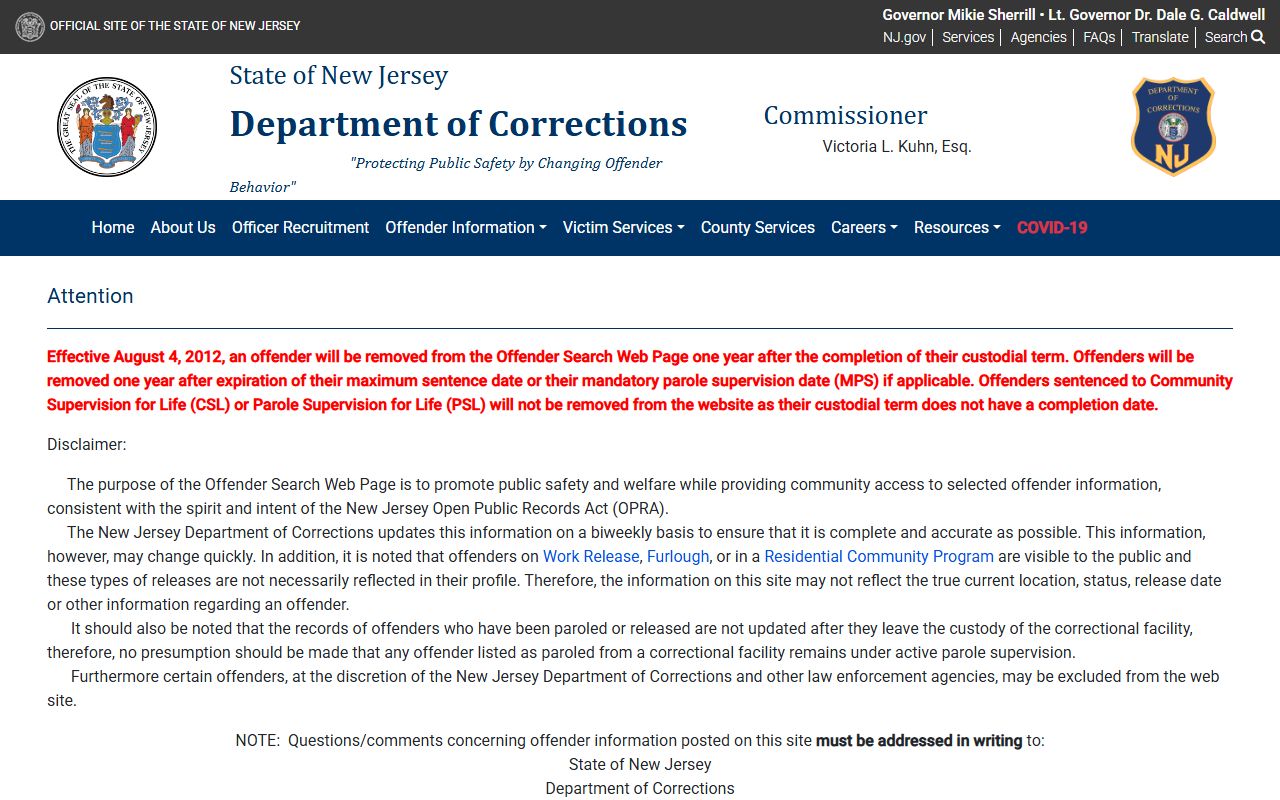
Use NJDOC as the state-prison confirmation step after checking the court case and county custody path.
Restricted, Sealed, Expunged, and Juvenile Records
Not every court record after an arrest remains fully public. The research points to OPRA and court-record limits rather than a universal open-access rule. Juvenile detention records are generally not public jail-roster content. Sealed or expunged records may be hidden from ordinary public search. Ongoing investigations and criminal investigatory records may also be limited. The correct route depends on the record type: court-record questions belong with NJ Courts, agency records belong with the agency custodian, and custody-status questions belong with the jail, NJDOC, BOP, ICE, or VINELink.
OPRA also does not override every court-rule or statutory restriction. For jail and prison records, the Government Records Council text recognizes exemptions and records that can be withheld or redacted. For court files, use court procedures and NJ Courts access channels rather than asking NJDOC for filings that it does not maintain.
Background Check Considerations
Court records after an arrest can be useful for public-record navigation, but they are not a substitute for a legally compliant background check. A casual search may miss sealed records, expunged records, name variations, municipal records, federal records, or out-of-state cases. It may also show an arrest without a conviction. For employment, tenant screening, credit, insurance, and other regulated decisions, use procedures that comply with the Fair Credit Reporting Act and applicable law.
Important: This site is not a consumer reporting agency, and public-record navigation should not be used for FCRA-regulated decisions.
OPRA, Court Records, and Arrest Records
New Jersey OPRA, N.J.S. 47:1A-1 et seq., is the statewide public-records law for government records, but it is not a universal release rule for every arrest, investigative, jail, prison, or court record. The research notes that the Government Records Council's readable OPRA text, effective September 3, 2024, includes access policy, exemptions, response deadlines, denial appeal options, and criminal-investigation provisions. Unless a shorter period applies, the custodian generally must grant or deny access as soon as possible and no later than seven business days, with a 14-business-day period for commercial-purpose or certain review needs when notice is given.
The New Jersey OPRA Central page is the records-request hub for state agency records.
Use OPRA for identifiable agency records, and use NJ Courts tools for the court case itself.